
Terry Cooper

Looking at the players in the chronological order of their loan spells the first up is Terry Cooper. A Welsh Youth International, he started his career with Newport County as something of a utility player playing in midfield or at full back. After a total of around 70 games for Newport he joined Notts County in the summer of 1970 but made only made a couple of first team appearances in central defence over the next two seasons. Then due to an injury crisis in the middle of December 1971 Lincoln manager David Herd brought Cooper in on a month’s loan to play alongside new signing John Kurila as a central defender with a view to a permanent transfer. His first game produced a 2-1 home win over Stockport, but after an away defeat at Southend and a home win over Workington which saw him play in midfield, the return to fitness of Terry Branston and the signing of Tommy Spencer to form a new defensive partnership saw him out of the side. According to Herd, despite efforts to make the signing permanent Cooper was ‘reluctantly’ released to return to Meadow Lane. Whether this was due to financial reasons or whether Notts wanted him back is not clear, but he continued to be no more than a fringe player with the third tier side, making just five substitute appearances, plus one start in defence.
Cooper appeared in midfield for Notts County in their first game of the following season then it was back to the reserves until David Herd came calling again. A fee of £5,000 was paid to bring in the Welshman on a permanent basis. Despite the optimism following the previous season’s fifth-place finish City had made a poor start to 1972/73 and after deputising in defence for the injured Spencer, Cooper was then played in midfield to provide some much-needed strength and bite. For a time, this worked well, with City reaching third place in the table before results began to deteriorate as the player’s limitations as a midfielder began to become evident. A run of only one win in ten games saw the departure of Herd and the appointment of the 28-year-old Graham Taylor in his place. After several weeks out injured in the New Year Cooper returned to the side alongside Terry Branston in defence for a game which saw Taylor’s first win as a manager. He retained his place in that position for the remainder of the season and the majority of the next three, becoming one of the mainstays of the record-breaking 1975/76 Fourth Division championship season.
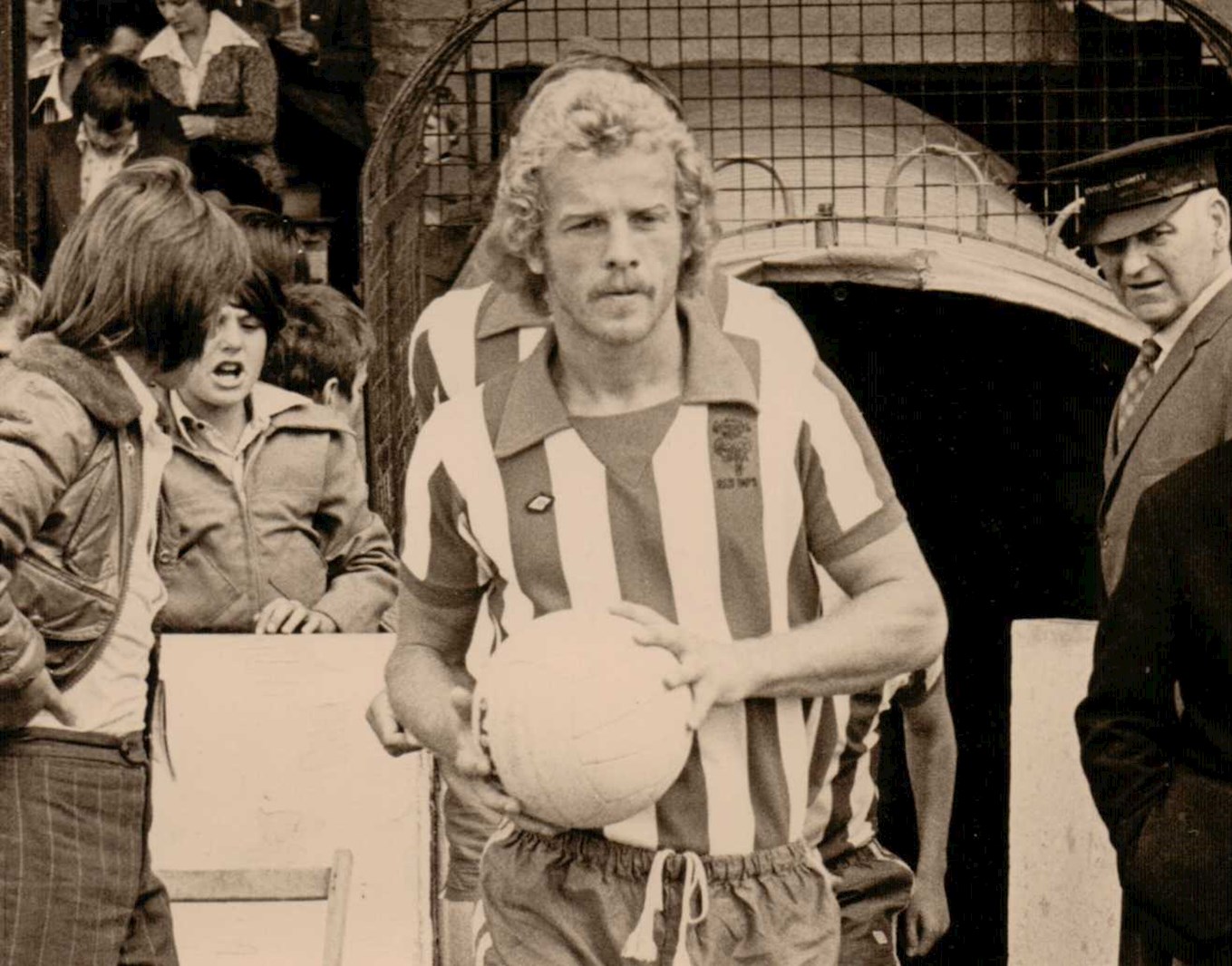
Along the way Cooper was voted Imps Player of the Season for the 1974/75 season and was nominated in the PFA Divisional Awards for the Fourth Division team of the year. However, as the 1976/77 season in Division Three went on there were signs of a deteriorating relationship between player and manager and it seems quite possible that he would have left the club the following summer if Taylor himself had not done so. As it was, Cooper remained with City through the following two years of struggle before being sold to Bradford City by Colin Murphy following City’s relegation back to the fourth tier – despite having won the Player of the Season award for a second time.
There’s no doubt that Terry Cooper’s arrival on a permanent basis was a huge success, nor that what David Herd saw of him in his brief loan spell was enough to persuade the manager to later sign him on a permanent basis. Cooper’s total number of appearances for the Imps came to just short of 300 including playing a full part in one of the greatest seasons in the club’s history. What is perhaps surprising is that in the poll carried out in 2007 to nominate City’s ‘Top 100 League Legends’ he only came in at no. 63.