
Group D

Tony Cunningham

Cunningham joined City from Stourbridge in 1979 for £20,000 and spent three seasons with the Imps. He made a sensational start to his career, getting the better of Norman Hunter no less to register a goal in the cup against Barnsley.
He then went on to form a deadly partnership with Mick Harford and then Gordon Hobson as the stylish Imps swept aside the Fourth Divison and headed for the second. He grabbed 12 league goals in the 1979/80 season, following that up with an injury-hit 1980/81 where he notched just six.
He was ever-present during the 1981/82 season where City so narrowly missed out on promotion to the second tier, drawing the final game 1-1 at Fulham. 46 games, 11 league goals but no promotion and that meant only one thing; he’d need to leave to progress.
The following season he had already got three on the board by the time Norman Hunter cropped up again, this time as manager of Barnsley, taking the young player who’d terrorised him to Oakwell for £80,000, around £275,000 today.
He later played for Manchester City, Newcastle, Sheffield Wednesday and Bolton amongst others, before settling back in Lincoln where he now works as a solicitor.
Phil Stant

Prolific striker and all round hard nut Stant initially disappointed in a Lincoln shirt, signing in 1990 with a reputation for grabbing goals already firmly earned he failed to hit the target once in seven outings. He was written off as a victim of the curse of the well-known striker at Lincoln (see Leo Fortune West & Joe Allon).
However, his work with Lincoln City wasn’t done and in 1996 John Beck snapped him up to provide some ferocity and aggression to the Imps forward line. He made his second Imps debut away at Hull on Boxing Day of 1996, and scored. He scored in his next four games, including two as we beat Doncaster 3-1 in late January. Whatever ‘curse’ had stuck in 1990 was firmly restricted to a single month.
He wasn’t just scoring robust headers and close range scrambles either. His neat little flick against Swansea at Sincil Bank was voted Goal of the Season by DF, and a stunning strike against Scunthorpe came in third.
Stant’s arrival signalled the end for giant Dutchman Gijsbert Bos and the ageing target man went on to make over 80 appearances for City averaging a goal every four games, although a majority of those came in that first fruitful season. He moved behind the scenes and appeared sporadically as a substitute as we got promoted, and then relegated. When John Reames relinquished the manager’s role in 2000 Phil
Dixie McNeil

McNeil joined City in 1972 for a fee of £9500 from Northampton. He went on to establish himself as one of the most prolific scorers of the modern age, banging 53 league goals in just 96 appearances.
Those who saw him play still talk of his prowess today, his no-nonsense approach to the game that yielded constant results. The early 1970s were a progressive time for the Imps, building on a horrible 1960s and McNeil gave the fans something to cling to. Most of all though, he scored lots and lots of goals.
Somewhat surprisingly, he was sold by Graham Taylor in 1974 for £20,000 despite being top scorer in successive seasons. His move to Hereford didn’t stop the goals either, he spent three years as their leading scorer too. In 1975-76, as City were winning the fourth division at a canter, he was also the top goals corer of all four divisions of English football.
McNeil was a Third Division winner twice, once in 1975/76 and again in 1977/78 with Wrexham. He retired from professional football in 1983.
Gavin Gordon
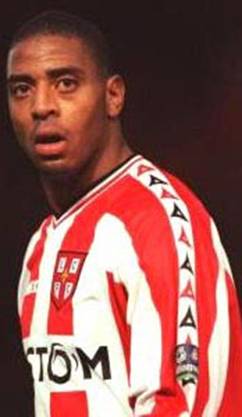
The signing of Gavin Gordon was something of a coup back in 1997. Gordon was a promising young striker with our rivals Hull City. He was rated highly there and had found a knack of coming off the bench to score. He netted an 81st minute equaliser for Hull against Darlington in November 1997. They lost 4-3 and by the 8th of November he was in a City shirt, exchanged for £30,000. John Beck was no mug; he knew a player when he saw one.
Gordon was a tall and strong forward who also had a great burst of pace in his locker. He was the classic John Beck forward, and even He immediately won the hearts of the Imps faithful a winning goal at Colchester in just his fifth game. He spent the rest of the season drifting in and out of the side as Lincoln won automatic promotion.
Normally a centre forward who wins automatic promotion is revered for years at his club, but Gordon was a member of the most unpopular Imps side to ever win promotion. Despite his obvious talents he didn’t always get the plaudits he deserved from the football world. He couldn’t keep us in the third tier the next season. His net input was five goals, six yellow cards and one sending off. His reputation as a bustling target man was being cemented, even if he wasn’t scoring the goals to justify it.
After relegation, he matured as a player, it might have been the input of the original hatchet centre forward Phil Stant. Gordon added goals to his repertoire, finishing the 1999/00 season with 13. The next season Gordon kicked on even more, seemingly scoring for fun. He scored twice in games against Kidderminster (3-3), Barnet (3-4) and Cardiff (2-3) on his way to amassing 11 goals before Christmas. Those two goals against Cardiff convinced the welsh side to pay us £275,000 for his services just before the festivities, and just three games into his Cardiff career he was off the mark again.
Vote Now
[poll id=”9″]